Why outsource HR? Companies outsource HR because the work has become too specialized for one generalist, and the cost of getting it wrong keeps rising. Outsourcing gives a small or mid-sized company access to payroll, benefits, and compliance specialists for a predictable monthly fee, without building a department.
In 2026 the case got sharper. Federal Form I-9 enforcement tightened in March. New overtime and tip rules under the One Big Beautiful Bill Act changed what employers have to track. And HR itself keeps getting more expensive to staff.
Here are the benefits, the honest trade-offs, and a simple way to build the case for your leadership team.
The benefits of outsourcing HR services start with breadth
An in-house HR hire gives you one person. That person is expected to know payroll tax, benefits law, leave rules, recruiting, and employee relations, in every state where you have staff.
The median U.S. HR manager earned $140,030 in May 2024, according to the Bureau of Labor Statistics. The median HR specialist earned $75,940 in May 2025. Either way, you are paying for one set of skills and hoping it covers everything.
Outsourcing flips that. You get a team with a specialist in each area, and you pay for the share of their time your company actually uses.
Compliance risk went up in 2026
The strongest answer to why outsource HR this year is risk. Rules change constantly, and enforcement is getting stricter.
Form I-9 is the clearest example. Paperwork violations carry civil penalties of $288 to $2,861 per form, under the inflation adjustment published in the Federal Register on January 2, 2025.
In March 2026, ICE updated its inspection guidance and reclassified more than 10 categories of common errors as substantive violations. Those errors used to qualify for a 10-day correction period. Now they can be fined immediately.
Fines are assessed form by form. A company with five flawed forms faces roughly $1,440 to $14,300 in paperwork penalties alone.
I-9 is one area of many. Overtime and tip reporting changed under the One Big Beautiful Bill Act, and every headcount threshold adds new obligations as you grow. An outsourced HR team tracks these changes as part of the job. A stretched generalist tends to find out later.
Costs become predictable
In-house HR costs are lumpy. A resignation means months of recruiting, a vacancy, and training a replacement. A claim or an audit brings legal fees nobody budgeted.
Outsourced HR runs on a monthly fee, usually tied to headcount. You know the number in advance, and it scales with your team. For typical pricing, see what HR outsourcing costs.
Leadership gets its time back
In most small companies, HR does not sit with an HR professional. It sits with a CFO, a COO, or the founder. Every hour they spend on enrollment files or payroll corrections is an hour off the work only they can do.
Outsourcing moves that work to people who do it every day. Your leaders keep the decisions. They lose the paperwork.
Employees get faster, better answers
Employees notice HR quality. A benefits question that sits for a week, or a paycheck that is wrong twice, costs trust quickly.
A dedicated outsourced team gives employees a clear place to take questions and a consistent answer every time. For a closer look, see how an outsourced HR company handles employee inquiries.
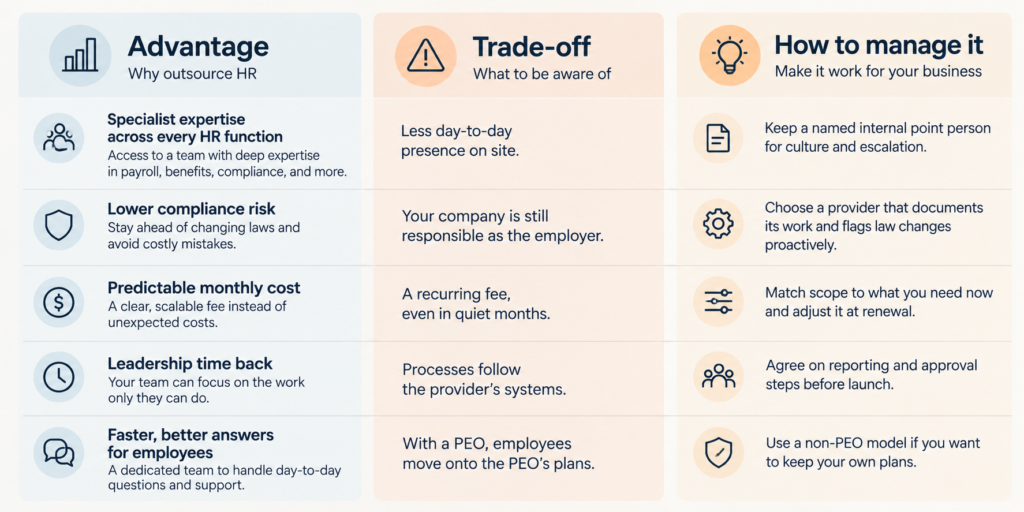
The pros and cons of outsourcing HR
Outsourcing has trade-offs. Knowing them up front leads to a better decision and a better contract.
| Advantage | Trade-off | How to manage it |
| Specialist expertise across every HR function | Less day-to-day presence on site | Keep a named internal point person for culture and escalation. |
| Lower compliance risk | Your company is still responsible as the employer | Choose a provider that documents its work and flags law changes proactively. |
| Predictable monthly cost | A recurring fee, even in quiet months | Match scope to what you need now and adjust it at renewal. |
| Leadership time back | Processes follow the provider’s systems | Agree on reporting and approval steps before launch. |
| Stronger benefits guidance | With a PEO, employees move onto the PEO’s plans | Use a non-PEO model if you want to keep your own plans. |
Most of the cons come down to fit. The right provider and the right model remove most of them. If you are weighing ongoing outsourcing against a one-time project, see HR consulting vs. HR outsourcing.
Outsourcing usually costs less than building a department
Is it cheaper to outsource HR? Compared with building an in-house department of the same breadth, it usually is for small and mid-sized companies. You share specialists instead of employing each one.
It is not always cheaper than the status quo. If HR lives with your CFO today at no visible cost, outsourcing adds a line item. The honest comparison counts what that arrangement already costs in leadership hours, errors, and exposure.
How to build the business case for your leadership team
A clear case fits on one page. Put these lines side by side.
| Line item | What to include |
| In-house cost | Salary, benefits, payroll taxes, HR software, training, and backup coverage for each HR hire you would need. |
| Outsourced cost | The monthly fee at your current headcount, plus any one-time setup or transition cost. |
| Leadership time | Hours per month your CFO, COO, or founder spends on HR, at their loaded hourly rate. |
| Risk exposure | Known gaps, such as I-9 accuracy, an outdated handbook, multi-state registrations, or an upcoming 50-employee threshold. |
| Growth plan | Headcount and new states planned over the next 12 to 24 months. |
Most companies find the decision turns less on the fee and more on the last two rows. Risk and growth are where in-house arrangements break.
If timing is still the open question, our guide on when to outsource HR walks through the headcount thresholds and warning signs.
Where Kona HR fits
Kona HR builds outsourced HR around the business case above. We run payroll, benefits administration, compliance, and employee relations without co-employment, so your company stays the employer and keeps its own benefits plans.
As a licensed benefits and business insurance brokerage, we can also benchmark your benefits and business insurance alongside the HR work. We support businesses nationwide from offices in New York, Palm Beach, Denver, Southport, and Richmond, with deep experience in hedge funds and private equity firms.
If the question in front of you is why outsource HR now rather than next year, the compliance changes above are usually the answer.
Frequently asked questions
Why do companies outsource HR?
Companies outsource HR to gain specialist expertise, reduce compliance risk, and control costs without building a full HR department. Outsourcing gives a small or mid-sized business access to payroll, benefits, and compliance specialists for a predictable monthly fee, and it frees leaders who were handling HR as a side job.
What are the benefits of outsourcing HR services?
The benefits of outsourcing HR services include access to specialists across payroll, benefits, and compliance, a lower risk of costly errors, and predictable monthly costs that scale with headcount. Employees get faster answers, leaders get time back, and law changes are tracked proactively instead of discovered later.
What are the disadvantages of outsourcing HR?
The disadvantages of outsourcing HR include less on-site presence, processes that follow the provider’s systems, and a recurring fee. With a PEO, employees also move onto the provider’s benefits plans. Most of these trade-offs can be managed by choosing the right model and agreeing on reporting and escalation steps up front.
Is it cheaper to outsource HR?
Outsourcing HR is usually cheaper than building an in-house HR department with the same range of expertise, because you share specialists rather than employing them. It can cost more than the status quo if HR currently sits with an executive, but that arrangement carries hidden costs in leadership time, errors, and compliance exposure.
How does HR outsourcing reduce costs?
HR outsourcing reduces costs by replacing the salaries, benefits, software, and training of in-house HR staff with one monthly fee. It also helps prevent penalties from compliance errors, avoids coverage gaps when HR staff leave, and returns time to executives who were handling HR work at a much higher hourly cost.
Does outsourcing HR reduce compliance risk?
Outsourcing HR reduces compliance risk when the provider tracks law changes, audits records such as Form I-9s, and keeps policies current. Your company remains responsible as the employer, so choose a provider that documents its work. Form I-9 paperwork violations alone carry penalties of $288 to $2,861 per form.
Will outsourcing HR hurt company culture?
Outsourcing HR does not have to hurt company culture. Culture comes from leaders and managers, and those roles stay in-house. Outsourcing usually removes administrative friction, such as payroll errors and slow benefits answers, that erodes trust. Keep a named internal point person so employees always know who represents the company.
Build your HR business case with real numbers
Tell us your headcount, your states, and how HR is handled today. Kona HR will put your in-house cost, your outsourced cost, and your compliance exposure side by side, so the decision rests on numbers rather than guesswork.