Leaving a PEO means taking back the employer role you shared through co-employment. Your company moves payroll onto its own tax ID, sets up its own benefits and workers’ compensation, and decides who runs HR from there. The cleanest exit date is January 1. Start planning about 90 days out.
It is a real project, but a well-worn one. Most of the risk sits in payroll taxes and benefits continuity. The rest is getting your records back.
Below is why companies leave, how timing affects your taxes, a step-by-step checklist, and the alternatives to a PEO once you are out.
Why companies leave a PEO
A PEO often makes sense early. It gives a small company pooled benefits and a full HR back office from day one. The fit tends to change as the company grows.
- Renewal costs rise, and the bundled fee makes it hard to see what you pay for each service.
- You want your own benefits plans, carriers, and claims data instead of the PEO’s master plan.
- You have outgrown a standardized service model and want an HR team that knows your business.
- Investors, auditors, or a buyer want the company to be its own employer of record.
- You need flexibility that the PEO’s policies and systems do not allow.
None of these mean the PEO failed. They usually mean the company changed.
January 1 is the cleanest exit date
When you leave a PEO, your employees become employees of your company under your own EIN. The date you choose matters for payroll taxes.
On January 1, the switch is simple. Wage bases reset for the new year anyway. Each employee gets one W-2 from the PEO for the old year and one from you for the new year.
Leaving a PEO mid-year creates two problems. Employees receive two W-2s for the same year. And unless your PEO is IRS-certified, the federal wage bases for Social Security and FUTA can restart under your EIN. You end up paying some employer taxes twice on the same people. With the 2026 Social Security wage base at $184,500, that cost adds up fast for higher earners.
A certified PEO, or CPEO, is treated as a successor employer under federal law, so federal wage bases carry over. State unemployment tax follows each state’s own rules and may still reset. Check your PEO against the IRS’s published CPEO list, and confirm the tax treatment with your tax advisor before you set a date.
For a January 1 exit, October is the month to start. That leaves time for notice, state registrations, and a new benefits plan that goes live the day PEO coverage ends.
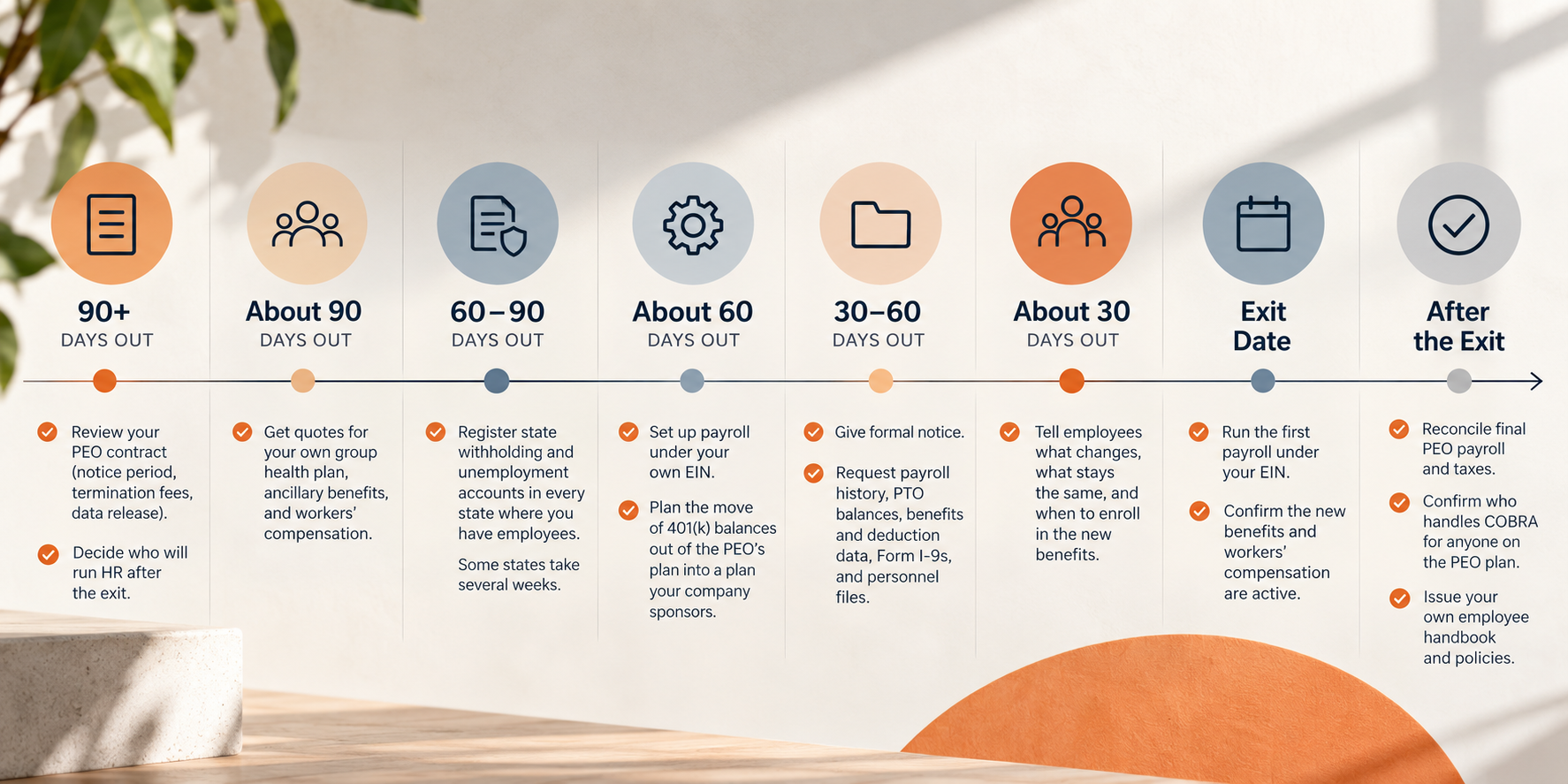
Leaving a PEO checklist
Work through these in order. Your contract’s termination clause sets the real timeline, so read it first.
| When | What to do |
| 90+ days out | Review the PEO contract for the notice period, termination fees, and what data the PEO will release. Decide who runs HR after the exit. |
| About 90 days out | Get quotes for your own group health plan, ancillary benefits, and workers’ compensation, effective the day PEO coverage ends. |
| 60 to 90 days out | Register state withholding and unemployment accounts in every state where you have employees. Some states take several weeks. |
| About 60 days out | Set up payroll under your own EIN. Plan the move of 401(k) balances out of the PEO’s plan into a plan your company sponsors. |
| 30 to 60 days out | Give formal notice. Request payroll history, PTO balances, benefits and deduction data, Form I-9s, and personnel files. |
| About 30 days out | Tell employees what changes, what stays the same, and when to enroll in the new benefits. |
| Exit date | Run the first payroll under your EIN. Confirm the new benefits and workers’ compensation are active. |
| After the exit | Reconcile final PEO payroll and taxes. Confirm who handles COBRA for anyone on the PEO plan. Issue your own handbook and policies. |
The two failure points are coverage gaps and missing records. A benefits plan that starts a day late, or a missing I-9 file, is far harder to fix after the exit than before it.
What happens to benefits when you leave
Coverage under the PEO’s master health plan ends on your exit date. Your new plan needs to start the next day.
Losing PEO coverage is a qualifying event, but employees still have to actively enroll in the new plan. Run it like an open enrollment, with clear deadlines and a side-by-side plan comparison.
Retirement savings need a new home too. If employees are in the PEO’s 401(k), balances move to a plan your company sponsors. Flexible spending and HSA arrangements, life and disability coverage, and COBRA for former employees each need a named owner in the transition plan.
The alternatives to a PEO
Leaving a PEO does not mean doing everything yourself. The real alternatives differ mainly in how much you keep in-house.
| Option | How it works | Best for |
| Outsourced HR (non-PEO) | A provider runs payroll, benefits administration, compliance, and employee relations. You stay the sole employer with your own plans. | Companies that want PEO-level support without co-employment |
| ASO | The provider handles payroll and HR administration. You keep the liabilities and more of the day-to-day work. | Companies with some internal HR capacity |
| Unbundled setup | A separate payroll provider, benefits broker, and HR consultant. | Companies with a strong internal lead to coordinate vendors |
| In-house HR team | You hire HR staff and buy your own systems. | Larger companies with the headcount to justify it |
| A different PEO | You switch providers but keep co-employment. | Companies happy with the model but not the provider |
For a closer look at how these models compare, see HR consulting vs. HR outsourcing. If you are unsure whether you need outside HR at all after the exit, our guide on when to outsource HR walks through the headcount thresholds.
Where Kona HR fits
Kona HR is not a PEO, which is exactly why PEO exits suit us. As a licensed benefits and business insurance brokerage, we place your own group health, ancillary, and workers’ compensation coverage. Our outsourced HR team then runs payroll, benefits administration, and compliance under your EIN.
That keeps the whole exit with one firm instead of three. We support businesses nationwide from offices in New York, Palm Beach, Denver, Southport, and Richmond, with deep experience in hedge funds and private equity firms.
Not every company should leave. If your PEO is still the right model, we can review the renewal and manage the relationship on your behalf.
Frequently asked questions
How do you leave a PEO?
Leaving a PEO starts with the termination clause in your contract, which sets the notice period and exit terms. From there, set up payroll under your own EIN, register state tax accounts, put your own benefits and workers’ compensation in place, recover employee records, and tell employees what is changing. Plan at least 90 days ahead.
When is the best time to leave a PEO?
The best time to leave a PEO is January 1. A calendar-year exit avoids restarting payroll tax wage bases mid-year and keeps each employee to one W-2 per employer per year. Companies targeting January 1 should begin planning in September or October to leave time for notice, registrations, and benefits.
What happens when you leave a PEO mid-year?
When you leave a PEO mid-year, employees receive two W-2s for the year and, unless the PEO is IRS-certified, Social Security and FUTA wage bases can restart under your EIN. State unemployment wage bases may also reset. The result is that some payroll taxes get paid twice on the same employees.
How do I exit a PEO like ADP TotalSource and manage HR independently?
Exiting a PEO such as ADP TotalSource, Insperity, or TriNet follows the same core steps: review the contract, set up payroll under your own EIN, secure your own benefits and workers’ compensation, and recover your records. To manage HR independently afterward, companies either build an in-house HR team or use a non-PEO outsourced HR provider.
What are the alternatives to a PEO?
The main alternatives to a PEO are non-PEO outsourced HR, an administrative services organization, an unbundled setup of separate payroll, benefits, and HR providers, or an in-house HR team. Each option keeps your company as the sole employer of record and lets you choose your own benefits plans and carriers.
Who helps companies transition out of a PEO?
Companies transitioning out of a PEO typically work with an HR outsourcing firm, a benefits broker, and a payroll provider, or with one firm that covers all three. The right partner coordinates benefits start dates, state tax registrations, and records transfer so the exit happens without coverage gaps or payroll errors.
Can someone manage my PEO relationship for me?
Someone can manage your PEO relationship for you. An independent HR consultant or benefits broker can review renewal pricing, benchmark the PEO’s benefits against the open market, and escalate service issues on your behalf. That gives a small company expert representation, and a clear view of whether staying in the PEO still makes sense.
How much does it cost to leave a PEO?
The cost of leaving a PEO depends on your contract and your timing. Expect possible termination fees, one-time setup for payroll and benefits, and duplicated payroll taxes if you leave a non-certified PEO mid-year. A fair comparison sets the PEO’s all-in fee against the full cost of each service purchased separately.
Plan your PEO exit before open enrollment
Tell us which PEO you use, your headcount, and your states. Kona HR will review your contract terms, price your own benefits and workers’ compensation, and map out a January 1 exit.