What is an ICHRA? An ICHRA, or Individual Coverage Health Reimbursement Arrangement, is an employer-funded health benefit that reimburses employees tax-free for individual health insurance premiums instead of enrolling them in a group plan. The employer sets a fixed monthly allowance, employees buy their own coverage, and the employer’s cost becomes predictable rather than renewal-driven.
ICHRA has moved from fringe idea to mainstream option quickly. More than 20,000 U.S. businesses now offer one as their primary health benefit, a 53 percent jump from 2025, and covered lives passed 500,000 at the start of 2026 according to the HRA Council’s fifth annual Growth Trends report.
The reason is simple. Group renewals are running 6.5 to 9.5 percent again, for the fourth consecutive year, and an ICHRA is the only structure that lets an employer decide what health benefits will cost next year rather than find out. Here is how it works, where it wins, and where it does not.
What does ICHRA stand for?
ICHRA stands for Individual Coverage Health Reimbursement Arrangement. It was created by federal rule in 2019 and became available to employers for plan years beginning January 1, 2020.
It is an HRA, which means it is employer-funded only. Employees cannot contribute to it and there is no account balance they own. The employer reimburses eligible expenses up to the allowance, and unused allowance stays with the employer.
How does an ICHRA work?
The mechanics are straightforward. You set a fixed monthly allowance per employee, with no IRS maximum and no minimum. You define which employee classes are eligible, and you may vary the allowance by class and by age and family size within a class. Employees buy individual coverage on or off the ACA marketplace and must be enrolled in individual health insurance or Medicare to participate. They substantiate coverage annually and premium payment at reimbursement. You then reimburse tax-free, excluded from the employee’s income and free of payroll tax for you. Your payroll and deduction handling also needs to reflect the arrangement correctly.
Your total exposure is the allowance multiplied by participating employees. That is the entire budget. There is no renewal increase, no large-claimant surprise, and no stop-loss negotiation.
What are the ICHRA employee classes?
You cannot offer an ICHRA and a traditional group plan to the same class of employees, but you can split your workforce into classes and treat them differently. The permitted classes include:
- Full-time, part-time, and seasonal employees
- Employees covered by a collective bargaining agreement
- Employees in a waiting period
- Salaried and hourly employees
- Employees in the same insurance rating area
- Temporary employees of staffing firms
- Employees under 25 at the start of the plan year
- Non-resident aliens with no U.S.-source income, and combinations of the above
A common design is a group plan for headquarters staff and an ICHRA for remote employees in states where your group network is thin. Rating-area classes carry minimum class size requirements when you also offer a group plan, so the design needs checking against your headcount before you commit.
What does an ICHRA cost?
You decide, and that is the entire point. There is no statutory contribution limit, which is the main structural difference from a QSEHRA. Employers commonly benchmark the allowance against the lowest-cost silver plan in each employee’s rating area, then set the allowance between 60 and 100 percent of that premium.
For context, KFF put the 2025 average employer contribution toward single coverage at roughly $7,885 a year, about $657 a month. An allowance meaningfully below local silver premiums will read to employees as a benefit cut regardless of how it is framed. Platform data suggests most employers calibrate reasonably: roughly 60 percent of enrolled employees on one major ICHRA platform had more than 75 percent of their premium covered by the allowance, and another 30 percent had 50 to 74 percent covered.
Administration is separate and typically runs $20 to $50 per participating employee per month for a platform handling substantiation, class management, affordability calculation, and reporting.
This is a fundamentally different cost structure from fully insured vs self insured funding, where claims experience and renewal pricing remain major variables.
What are the ICHRA affordability rules?
If you have 50 or more full-time equivalent employees, your ICHRA must be affordable or you risk employer mandate penalties. The test differs from the group plan test. For a group plan, affordability looks at the employee’s cost for your lowest-cost self-only option. For an ICHRA, it looks at the employee’s remaining cost for the lowest-cost silver plan in their rating area after your allowance is applied.
The formula: the monthly lowest-cost silver plan premium for self-only coverage, minus your monthly allowance, must not exceed the affordability percentage times monthly household income.
| Plan year | Affordability percentage | Source |
| 2026 | 9.96% | IRS Rev. Proc. 2025-25 |
| 2027 | 10.22% | IRS Rev. Proc. 2026-26, released July 21, 2026 |
The 2027 figure is the first time the ACA affordability percentage has exceeded 10 percent. Non-calendar-year plans continue using 9.96 percent until their new plan year begins.
Because the benchmark is local, affordability must be calculated per rating area, not once for the company. An allowance that clears the test in Denver may fail it in New York. This is the most common technical error in ICHRA design and the reason most employers use a platform rather than a spreadsheet. You may use the W-2, rate of pay, or federal poverty line safe harbors in place of actual household income. For plan years beginning January 1 through June 1, 2027, the FPL safe harbor is met when the employee’s required contribution does not exceed $135.92 per month.
ICHRA vs QSEHRA: which one applies to you?
| ICHRA | QSEHRA | |
| Employer size | Any size | Fewer than 50 FTEs |
| Group plan alongside it | Yes, to different classes | No |
| Contribution limit | None | $6,450 self-only / $13,100 family (2026) |
| Employee classes | 11 permitted classes | All eligible employees, same terms |
| Satisfies ACA employer mandate | Yes, if affordable | Not applicable, these employers are not ALEs |
| Coverage requirement | Individual coverage or Medicare | Minimum essential coverage |
| Premium tax credit | Employee waives PTC if offer is affordable | PTC reduced by the QSEHRA amount |
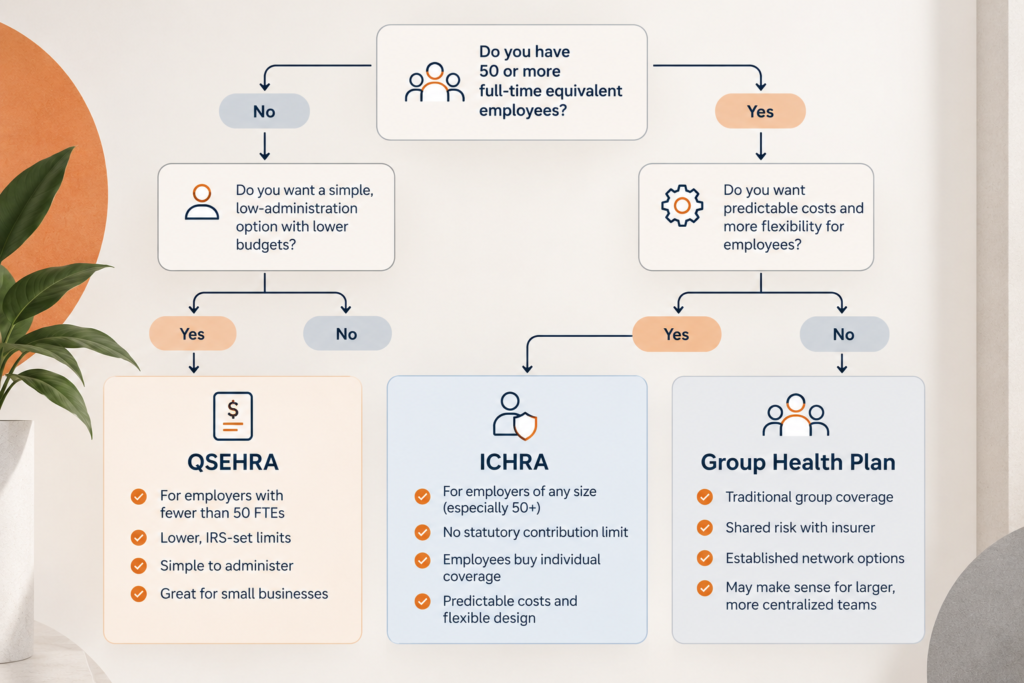
The practical rule: under 50 employees with no group plan and a desire for a simple capped benefit, QSEHRA is easier. At 50 or more employees, or when you want to segment your workforce or contribute above the QSEHRA caps, ICHRA is the only option. 2027 QSEHRA limits are typically released by the IRS in October.
Who is a good fit for an ICHRA?
- Remote and multi-state employers. A group plan built around a headquarters network serves distributed teams badly. Individual coverage is local by definition.
- Employers with unpredictable renewals, where one large claim resets the rate every other year.
- Companies with 50 to 250 employees facing double-digit increases. Applicable large employers are now the fastest-growing ICHRA segment, more than doubling on average year over year.
- Businesses offering coverage for the first time. More than two-thirds of small businesses now offering an ICHRA previously offered no health coverage at all.
- Workforces with varied needs, where a young employee wanting a low-premium bronze plan and a family managing chronic conditions are poorly served by the same group plan.
Where ICHRA is the wrong answer
- Thin individual markets. ICHRA is only as good as the plans available in your employees’ counties.
- Employees with established specialists. Individual market networks are often narrower than group networks.
- Higher-income workforces with rich group coverage. Converting a low-deductible PPO to a defined contribution is a benefit reduction and will be received as one.
- No appetite for change management. Employees have to shop for insurance, most for the first time, and that needs real communication support.
- Subsidy interaction. If the offer is affordable the employee cannot claim a premium tax credit, so model lower-wage workforces carefully given the expiration of the enhanced advance premium tax credits.
How do you set up an ICHRA?
Working backward from a January 1 effective date:
| When | What happens |
| Early September | Model it. Pull the census with home ZIP codes, get lowest-cost silver premiums by rating area, and compare allowance levels against your projected group renewal. Run the affordability test at each level, for each rating area. |
| Mid September | Decide class structure and allowance schedule. Confirm minimum class size rules if you are keeping a group plan for some employees. |
| Early October | Select an administration platform covering substantiation, class management, affordability calculation, reimbursement, and 1095-C support. |
| By October 2 | Issue the ICHRA notice. Employees must receive it at least 90 days before the plan year begins. This is the binding deadline on the whole project. |
| November and December | Enrollment support. This is where ICHRA implementations succeed or fail. Individual market open enrollment has its own deadlines that do not align with your internal calendar. |
| January 1 | Coverage effective, reimbursement processing begins. |
What are the compliance obligations?
An ICHRA is a group health plan under ERISA. That means a written plan document and Summary Plan Description, the ICHRA notice 90 days before the plan year, annual substantiation of individual coverage and substantiation of expenses at reimbursement, COBRA obligations because the ICHRA itself is continuation-eligible, Forms 1094-C and 1095-C with ICHRA-specific offer codes for applicable large employers, the PCORI fee on Form 720, Form 5500 if the plan covers 100 or more participants, and an annual opt-out opportunity for employees who prefer to claim a premium tax credit.
One useful development: beginning in 2026, all ACA bronze and catastrophic marketplace plans are treated as HSA-eligible high deductible plans per IRS Notice 2026-5. That lets more employees pair ICHRA reimbursement with HSA contributions, which materially improves the value of the arrangement for younger participants.
Where Kona HR fits
ICHRA is not a lighter administrative lift than a group renewal. It is a different one. Contribution strategy by class, affordability calculation by rating area, the 90-day notice, ACA reporting with ICHRA codes, and enrollment support. For employers that need broader support, ICHRA can also sit within full-service benefits administration rather than being managed as a standalone program..
Kona HR models ICHRA against your actual group renewal before you commit, designs the class and allowance structure, handles the notice and reporting calendar, and supports your employees through individual market enrollment. If the analysis says stay with group coverage, we say that. We serve employers nationwide from offices in New York, Palm Beach, Denver, Southport, and Richmond, which is exactly the multi-state footprint where ICHRA tends to make the most sense.
For employers looking beyond benefits alone, our outsourced HR services can support the wider HR function as well.
Frequently Asked Questions
What is an ICHRA?
An ICHRA, or Individual Coverage Health Reimbursement Arrangement, is an employer-funded health benefit that reimburses employees tax-free for individual health insurance premiums and, at the employer’s option, other qualified medical expenses. The employer sets a fixed monthly allowance instead of sponsoring a group health plan for that class of employees.
What does ICHRA stand for?
ICHRA stands for Individual Coverage Health Reimbursement Arrangement. It was established by federal regulation in 2019 and became available for plan years beginning January 1, 2020.
How does an ICHRA work for employers?
The employer sets a monthly allowance, defines which employee classes are eligible, and reimburses employees tax-free for individual health insurance premiums after they substantiate coverage. Total cost is the allowance multiplied by participating employees, which makes the budget fixed rather than renewal-driven.
Is an ICHRA good for employees?
It depends on the local individual market. Employees gain portable coverage that follows them between jobs and the ability to choose a plan that fits their situation. They lose the simplicity of a group plan and may face narrower networks. In counties with several competitive carriers employees generally do well, and in thin markets they may not.
Are ICHRA reimbursements taxable?
No. ICHRA reimbursements are excluded from the employee’s gross income and are not subject to payroll taxes for the employer, provided the employee is enrolled in qualifying individual health coverage and properly substantiates the expense.
What is the ICHRA affordability threshold for 2027?
For plan years beginning in 2027, an ICHRA is affordable when the employee’s cost for the lowest-cost silver plan in their rating area, after subtracting the employer allowance, does not exceed 10.22 percent of household income. The 2026 figure is 9.96 percent. Affordability must be calculated by rating area, not once for the whole company.
Can we offer an ICHRA and a group health plan at the same time?
Yes, but not to the same class of employees. You can offer a group plan to one permitted class and an ICHRA to another, for example a group plan at headquarters and an ICHRA for remote employees in other states. Minimum class size rules apply when classes are based on rating area and you also offer a group plan.
What is the difference between ICHRA and QSEHRA?
ICHRA is available to employers of any size, has no contribution cap, permits employee classes, and can satisfy the ACA employer mandate. QSEHRA is limited to employers with fewer than 50 full-time equivalents who offer no group plan, caps contributions at $6,450 for self-only and $13,100 for family coverage in 2026, and must be offered to all eligible employees on the same terms.
When do we need to give employees the ICHRA notice?
At least 90 days before the start of the plan year. For a January 1 effective date, the notice must be issued by approximately October 2.
Model ICHRA against your renewal before you commit
Tell us your headcount, your states, and your current renewal quote. Kona HR will model ICHRA, group coverage, and the alternatives side by side, design the class and allowance structure if ICHRA wins, and own the notice and reporting calendar either way.