What are ancillary benefits? Ancillary benefits are the coverages that sit alongside your medical plan: dental, vision, life, short-term and long-term disability, accident, critical illness, and hospital indemnity. They are called ancillary because they supplement major medical, not because they are optional to your employees, who consistently rank dental and vision among the benefits they value most.
That naming causes a real problem. “Ancillary” sounds like “extra,” so these lines get decided last, renewed on autopilot, and rarely benchmarked, while the medical plan absorbs all the attention and most of the budget.
With medical trend running 6.5 to 9.5 percent again for 2027, the ancillary layer is where employers still have room to improve a benefits package without a large budget increase. Here is what each line does, what it costs, and how to decide what to add.
What are ancillary benefits?
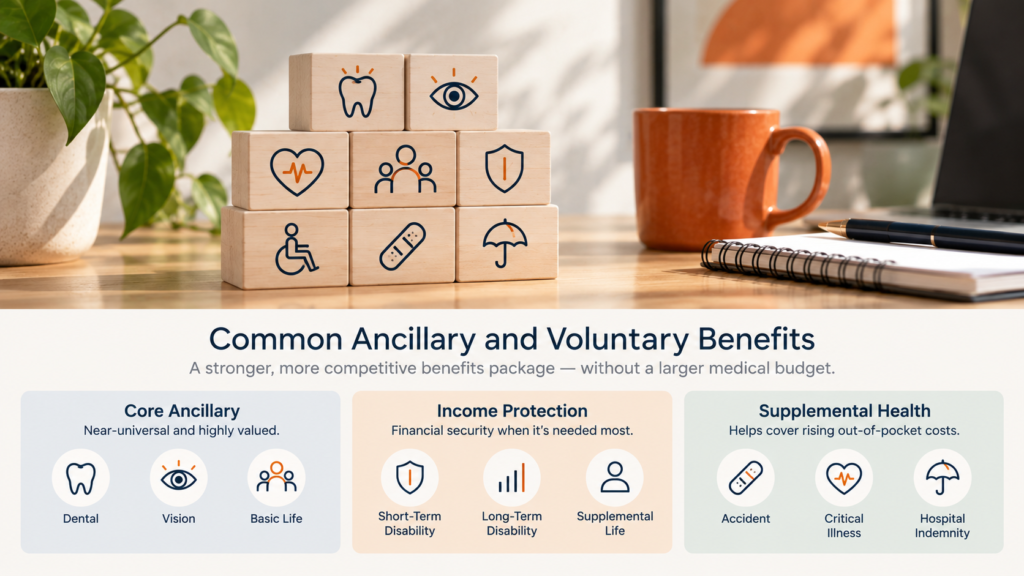
Ancillary benefits are non-medical insurance products offered alongside a group health plan. They fall into three practical groups.
Core ancillary covers dental, vision, and basic group life. These are near-universal at mid-sized employers and are treated as table stakes by candidates. Among small businesses offering health benefits, roughly 90 percent include dental and 80 percent include vision.
Income protection covers short-term disability, long-term disability, and supplemental life. These have the largest gap between how important they are and how often they are offered. Only about 41 percent of U.S.
employers offer short-term disability and 38 percent offer long-term disability, according to a 2026 analysis of more than 76,000 employer benefit plans. Roughly one in four workers entering the workforce will experience a disabling condition before retirement age.
Supplemental health covers accident, critical illness, and hospital indemnity. These pay cash directly to the employee on a triggering event, independent of the medical plan. They exist largely because deductibles have grown. The average single-coverage deductible reached $1,886 in 2025, up 17 percent over five years, and about a third of covered workers face a deductible of $2,000 or more.
What is the difference between ancillary and voluntary benefits?
The two terms overlap constantly, and the distinction is about funding, not product. Ancillary describes what the benefit is: a non-medical coverage line alongside the health plan. Voluntary describes who pays: the employee, through payroll deduction, usually at group rates the employer negotiated. The same product can be either. Dental is ancillary and employer-paid at one company, ancillary and voluntary at another.
| Employer-paid ancillary | Voluntary | |
| Who pays the premium | Employer, fully or partially | Employee, usually 100% |
| Employer cost | Direct budget line | Administration only |
| Typical participation | High, often 90%+ when contributory | Lower, 15% to 30% for supplemental health |
| Why offer it | Competitive package, retention | Broaden the package at near-zero cost |
| Common lines | Dental, vision, basic life, LTD | Critical illness, accident, voluntary life, hospital indemnity |
The strategic point: voluntary benefits let you widen your benefits package without adding to the benefits budget. If your medical renewal came back at 9 percent and you have no room to improve coverage, adding two or three voluntary lines is the move available to you.
What do ancillary benefits cost employers?
Rough per-employee-per-month ranges. Actual pricing depends on group size, demographics, industry, geography, and plan design.
| Benefit line | Typical employer cost (PEPM) | Notes |
| Dental | $25 to $50 single, $70 to $130 family | PPO accounts for over 80% of dental plans |
| Vision | $5 to $12 single, $15 to $30 family | Cheapest visible benefit you can add |
| Basic group life | $2 to $8 | Usually a flat amount or 1x to 2x salary |
| Short-term disability | $15 to $35 | Median benefit 60% of salary, commonly 26 weeks |
| Long-term disability | $15 to $40 | Median 60% replacement, 90-day elimination period at 68% of plans |
| Accident | $8 to $20 | Frequently offered as voluntary |
| Critical illness | $10 to $30 | Frequently voluntary, rate varies sharply by age |
| Hospital indemnity | $10 to $25 | Pairs with high-deductible medical |
| Voluntary lines | $0 | Employee-paid, employer covers administration only |
For most mid-sized employers, a full ancillary package of dental, vision, life, STD, and LTD lands somewhere between $60 and $130 per employee per month. That is meaningful but small next to a medical plan running $650 or more per employee per month for single coverage.
Where employers get the disability decision wrong
Benefit caps that quietly exclude your best-paid people. Median short-term disability caps run around $1,602 per week and long-term disability around $8,273 per month. A plan advertised as 60 percent salary replacement replaces materially less than 60 percent for anyone earning above roughly $165,000. Those employees believe they are covered at 60 percent. They are not, and they will discover it at the worst possible moment.
Misaligned STD duration and LTD elimination periods. If short-term disability runs 26 weeks but long-term disability has a 90-day elimination period, the two overlap and you paid for coverage twice. If STD runs 13 weeks against a 180-day LTD elimination period, the employee has a gap with no income. Aligning these two numbers is free and takes one conversation.
Five states also run mandatory disability programs: California SDI, New Jersey TDI, New York DBL, Hawaii TDI, and Rhode Island TCI. If you employ people in those states, your voluntary STD design has to coordinate with the statutory benefit rather than duplicate it.
Which ancillary benefits do employees actually use?
Offering a benefit and having employees enroll in it are different outcomes, and the gap is wide. Across employer groups from 2024 to 2026, average enrollment ran roughly 60 percent for dental, 56 percent for vision, and 47 percent for medical. Supplemental lines run much lower: about 22.7 percent for voluntary life and 18.5 percent for critical illness.
Low enrollment is usually a communication failure rather than a demand problem. Industry research consistently shows workers prioritize health, dental, and vision and cut the supplemental lines when household budgets tighten. When employees do not understand what critical illness pays or when it pays, they decline it by default. Three things move enrollment reliably.
- Explain the trigger, not the product. “Pays you $5,000 in cash if you are diagnosed with cancer, on top of your health plan” beats “critical illness coverage” every time.
- Connect it to the deductible they already have. Hospital indemnity and accident coverage make sense to an employee the moment they understand their own deductible number.
- Do not bury it at the end of open enrollment. By election 7 of 9, attention is gone.
How to decide what to add for 2027
A practical sequence for the September and October window.
| Step | What to do |
| 1. Benchmark honestly | Compare against the four or five companies you actually lose candidates to, not your industry nationally. If they offer LTD and you do not, that is a concrete gap. |
| 2. Fill income protection first | If you offer dental and vision but no disability coverage, LTD is the highest-value addition available. It is inexpensive and it prevents a personal financial catastrophe. |
| 3. Match supplemental to your medical design | If you moved to a high-deductible plan, hospital indemnity and accident coverage do real work. If your medical deductible is $500, they do much less. |
| 4. Use voluntary for what you cannot fund | Employee-paid at group rates costs you administration and nothing else, and it broadens what you can show a candidate. |
| 5. Fix the design details | Align STD and LTD. Check benefit caps against your actual salary bands. Confirm coordination with any state disability program you are subject to. |
| 6. Consolidate carriers where you can | Multiple ancillary carriers means multiple invoices, EDI feeds, reconciliation processes, and enrollment rules. Bundling often produces both a rate concession and less administrative work. |
The administrative reality
Every ancillary line you add is another carrier feed, another invoice to reconcile, another set of eligibility rules, and another place enrollment can break. An employer with six ancillary carriers is running six reconciliation processes every month.
This is the argument for consolidation and for treating ancillary benefits as part of your benefits administration plan rather than as a series of separate purchases. If your team is already stretched during open enrollment, adding three voluntary lines without an administration plan will produce enrollment errors in January.
Where Kona HR fits
Kona HR benchmarks your full benefits package, not just the medical plan, against what employers in your market and size band actually offer. That includes pricing the ancillary lines, checking disability design for the caps and elimination-period gaps most plans carry, structuring voluntary offerings that broaden the package without adding budget, and then administering the whole thing so the carrier feeds and enrollment records stay clean.
We support businesses nationwide from offices in New York, Palm Beach, Denver, Southport, and Richmond, including states with statutory disability programs that voluntary designs have to coordinate around.
Frequently Asked Questions
What are ancillary benefits?
Ancillary benefits are non-medical insurance coverages offered alongside a group health plan, including dental, vision, group life, short-term and long-term disability, accident, critical illness, and hospital indemnity. They supplement major medical coverage rather than replacing it.
What is the difference between ancillary benefits and voluntary benefits?
Ancillary describes the type of coverage, meaning a non-medical line alongside the health plan. Voluntary describes who pays, meaning the employee funds it through payroll deduction at employer-negotiated group rates. The same product, such as dental, can be employer-paid at one company and voluntary at another.
What are examples of ancillary benefits?
Common examples include dental insurance, vision insurance, group term life, short-term disability, long-term disability, accident insurance, critical illness insurance, and hospital indemnity coverage. Some employers also include legal plans, identity theft protection, and pet insurance in the ancillary category.
How much do ancillary benefits cost an employer?
A full package of dental, vision, basic life, short-term disability, and long-term disability typically runs $60 to $130 per employee per month depending on group size, demographics, and plan design. Voluntary lines that employees fund themselves cost the employer only the administrative effort.
Is long-term disability an ancillary benefit?
Yes. Long-term disability is an ancillary income protection benefit. Only about 38 percent of U.S. employers offer it, which makes it one of the clearest differentiators available at relatively low cost.
Why is employee enrollment in voluntary benefits so low?
Enrollment in supplemental lines runs roughly 18 to 23 percent, largely because employees do not understand what triggers a payout. Enrollment improves substantially when the benefit is explained by what it pays and when, and when it is connected to the deductible the employee already faces.
Should we offer ancillary benefits as employer-paid or voluntary?
Fund the core lines, dental, vision, basic life, and disability, where budget allows, because those drive retention and candidate perception. Offer supplemental health lines such as critical illness, accident, and hospital indemnity on a voluntary basis, which broadens the package at essentially no cost to the employer.
When should we review our ancillary benefits?
Review them at the same time as your medical renewal, typically September and October for January 1 plan years. Ancillary contracts often run on multi-year rate guarantees, so knowing which lines are open for negotiation this cycle determines what you can actually change.
Benchmark your full benefits package, not just the medical plan
Tell us your headcount, your states, and what you offer today. Kona HR will benchmark the whole package against your real competitors for talent, price the gaps, and fix the disability design details most plans get wrong.