When should you outsource HR? Outsource HR when the work is growing faster than anyone’s ability to do it correctly. For most small businesses, that moment shows up in one of two ways. HR has landed on someone whose real job is something else. Or the company is about to cross a headcount line that brings new legal obligations.
Federal employment law adds major requirements at 15, 20, 50, and 100 employees. Each one raises the cost of a mistake.
Below are the thresholds, the warning signs, and the math on hiring versus outsourcing. There is also a short list of HR work you should keep in-house no matter what.
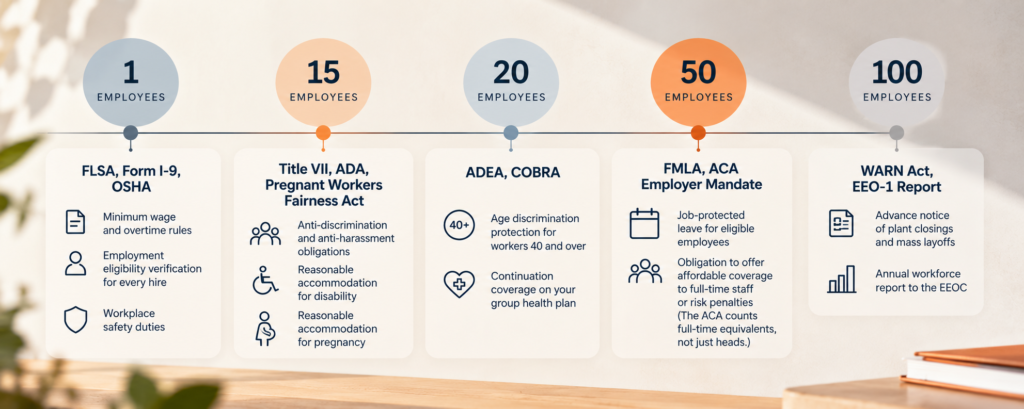
The headcount lines that change your HR obligations
Employment law scales with company size. These are the federal thresholds most small businesses hit first.
| Employees | What starts to apply | What it means in practice |
| 1 or more | FLSA, Form I-9, OSHA | Minimum wage and overtime rules, employment eligibility verification for every hire, and workplace safety duties. |
| 15 | Title VII, ADA, Pregnant Workers Fairness Act | Anti-discrimination and anti-harassment obligations, plus reasonable accommodation for disability and pregnancy. |
| 20 | ADEA, COBRA | Age discrimination protection for workers 40 and over, and continuation coverage on your group health plan. |
| 50 | FMLA, ACA employer mandate | Job-protected leave for eligible employees. An obligation to offer affordable coverage to full-time staff or risk penalties. The ACA counts full-time equivalents, not just heads. |
| 100 | WARN Act, EEO-1 report | Advance notice of plant closings and mass layoffs, and an annual workforce report to the EEOC. |
State law often starts sooner. The New York State Human Rights Law, for example, covers employers of every size. If you have people in more than one state, you are tracking more than one rulebook.
A company growing from 40 to 55 employees in a year crosses the most significant line on this chart. That is the classic moment to bring in outsourced HR. Ideally it happens before the 50th hire, not after.
Seven signs your business is ready to outsource HR
| The sign | What it usually means |
| HR belongs to your CFO, controller, office manager, or founder | Your most expensive people are doing administrative work, and HR gets their leftover attention. |
| The same payroll or benefits errors keep coming back | The process lives in one person’s head, with no second check. |
| You are about to cross 15, 20, or 50 employees | New federal obligations are weeks away. |
| You just hired your first employee in a new state | New payroll registrations, withholding rules, and leave laws. |
| Your handbook is out of date, or you do not have one | Policies that do not match current law become a liability in any dispute. |
| An employee issue came up that no one knew how to handle | A complaint, a leave request, or a termination is where small mistakes turn into claims. |
| Investors, auditors, or a buyer are asking for HR records | Due diligence exposes gaps fast, and fixing them on a deadline costs more. |
One sign is a nudge. Three or more usually means the risk has outgrown the arrangement.
Outsourcing vs. your first HR hire
The alternative to outsourcing is hiring. It helps to price that honestly.
The median U.S. HR specialist earned $75,940 in May 2025, according to the Bureau of Labor Statistics. The median HR manager earned $140,030 in May 2024. Benefits, payroll taxes, HR software, and training all come on top.
Then look at coverage. SHRM’s 2025 benchmarking puts the median at 1.98 HR staff per 100 employees. At that ratio, a 40-person company would carry less than one full-time HR person. It still needs payroll, benefits, compliance, and employee relations covered, including the weeks that one person is out.
Outsourcing gives a company that size access to specialists in each area for a predictable monthly fee. For typical pricing, see what HR outsourcing costs. For the full cost and risk comparison, see our 2026 business case for outsourcing HR.
What to outsource first
You do not have to hand over everything at once. Most companies start with the work that carries the most risk and repeats most often.
- Payroll and payroll tax filings. Errors here are immediate, and every employee sees them.
- Benefits administration. Enrollment, carrier feeds, COBRA notices, and renewals are detailed and deadline-driven.
- Compliance and recordkeeping. Form I-9s, required notices, the employee handbook, and policy updates as laws change.
- Employee relations support. A trained HR professional to call before a difficult conversation, not after it.
- Recruiting and onboarding, once the core administration is stable.
Timing within the year matters too
The cleanest start dates follow the calendar. A January 1 start gives you a full payroll tax year with one provider and one clean set of W-2s.
Starting before open enrollment matters just as much. The new team runs the renewal instead of inheriting it halfway through. For companies with January 1 plan years, that makes early fall the natural time to decide, and October a sensible deadline.
The HR functions you should keep in-house
Some HR work should stay with you no matter who runs the administration. The functions that should not be outsourced are the ones that define how your company leads its people.
- Final decisions on hiring, promotion, and termination. A good provider advises and documents. Your leaders decide. This holds even under a PEO.
- Culture and values. An outside firm can help you write them down. It cannot live them for you.
- Day-to-day management. Coaching, feedback, and performance conversations belong to managers.
- Compensation philosophy. A provider can benchmark pay and model options. Where you choose to pay relative to your market is a leadership call.
Sometimes outsourcing is not the answer yet
Outsourcing is not always the right next step. A company with a handful of employees in one state and simple payroll may be well served by payroll software and a reliable advisor on call.
A company with a strong in-house HR lead may not need outsourcing at all. It may need targeted help on specialist questions. That is a consulting engagement, and our guide to HR consulting vs. HR outsourcing explains the difference.
Where Kona HR fits
Kona HR works with small and mid-sized companies at exactly these moments. The approach to 50 employees. The first hire in a new state. The fund launch that needs HR from day one. We run outsourced HR services without co-employment, so you stay the employer and keep your own benefits plans.
If the question on your desk is when should you outsource HR, the answer is usually sooner than you think. Start with payroll and benefits administration, then add compliance and employee relations as you grow. We support businesses nationwide from offices in New York, Palm Beach, Denver, Southport, and Richmond.
Frequently asked questions
When should a small business outsource HR?
A small business should outsource HR when HR work has outgrown the person handling it or when the company is approaching a headcount threshold. Common triggers include reaching 15, 20, or 50 employees, hiring in a new state, recurring payroll errors, and HR landing on a CFO or office manager as a side job.
How many employees do you need before you need HR?
No federal law sets a headcount that requires an HR department, but obligations grow with size. Title VII and the ADA apply at 15 employees, COBRA at 20, and the FMLA and ACA employer mandate at 50. Most companies need dedicated HR support, in-house or outsourced, before they reach 50.
What HR functions should not be outsourced?
The HR functions that should not be outsourced are the ones that define leadership. Final hiring, promotion, and termination decisions, company culture, day-to-day management, and compensation philosophy should stay with your leaders. A provider can advise, document, and administer, but those decisions remain with your company.
What HR functions can be outsourced?
Most administrative HR functions can be outsourced, including payroll and payroll tax filing, benefits administration, COBRA, leave tracking, onboarding, Form I-9 and recordkeeping compliance, handbook and policy updates, recruiting support, and employee relations guidance. Many companies start with payroll and benefits, then add functions as they grow.
Is it better to hire an HR person or outsource HR?
Hiring an HR person is the better choice when you need someone on site every day and can fund a full salary and benefits. Outsourcing is the better choice when you need expertise across payroll, benefits, and compliance that one generalist cannot cover. Many companies outsource first and hire later.
Can you outsource HR if you already have an HR employee?
You can outsource HR if you already have an HR employee. Many companies keep an in-house HR generalist for culture and employee relations and outsource administrative work such as payroll, benefits administration, and compliance tracking. This frees the internal person for higher-value work and gives them specialist backup.
When should a company switch HR outsourcing providers?
A company should switch HR outsourcing providers when errors repeat, response times slip, or the provider cannot support new states or a larger headcount. Switching before open enrollment or the start of a new payroll year, rather than mid-cycle, makes the transition cleaner for employees and for tax filings.
Find out where your business sits
Tell us your headcount, your states, and who handles HR today. Kona HR will map your current obligations, flag what changes at your next threshold, and show you what to outsource first.