“No tax on overtime” is a federal income-tax deduction, created by the One Big Beautiful Bill Act, that lets eligible workers deduct the premium portion of their FLSA overtime pay (the “half” of time-and-a-half) for tax years 2025 through 2028. It is capped at $12,500 for single filers and $25,000 for joint filers, and it phases out above $150,000 and $300,000 in income. Overtime is still subject to payroll withholding and FICA, and workers claim the deduction on their tax return. Starting with 2026, employers must report qualified overtime separately on Form W-2.
Few payroll topics have generated more employee questions than “no tax on overtime.” Searches for when it starts and how it works run into the tens of thousands a month, and much of what circulates online is wrong. This guide lays out what the law actually does, who qualifies, and, most importantly for employers, what you are required to do about it.
What is the no tax on overtime deduction?
The One Big Beautiful Bill Act (OBBBA) created a new federal deduction for qualified overtime compensation. It is an above-the-line deduction, which means eligible workers can claim it whether or not they itemize. It does not make overtime completely tax-free, and it does not change how overtime is withheld from a paycheck. It reduces taxable income when the worker files their federal return.
The deduction applies to tax years 2025 through 2028 unless it is extended by future legislation.
When does no tax on overtime start?
The deduction is effective for the 2025 tax year, meaning overtime earned in 2025 is eligible, and workers first claim it on the federal return they file in early 2026. It continues through the 2028 tax year. So while the benefit is often called “2026,” it actually reaches back to overtime worked in 2025.
How does no tax on overtime work?
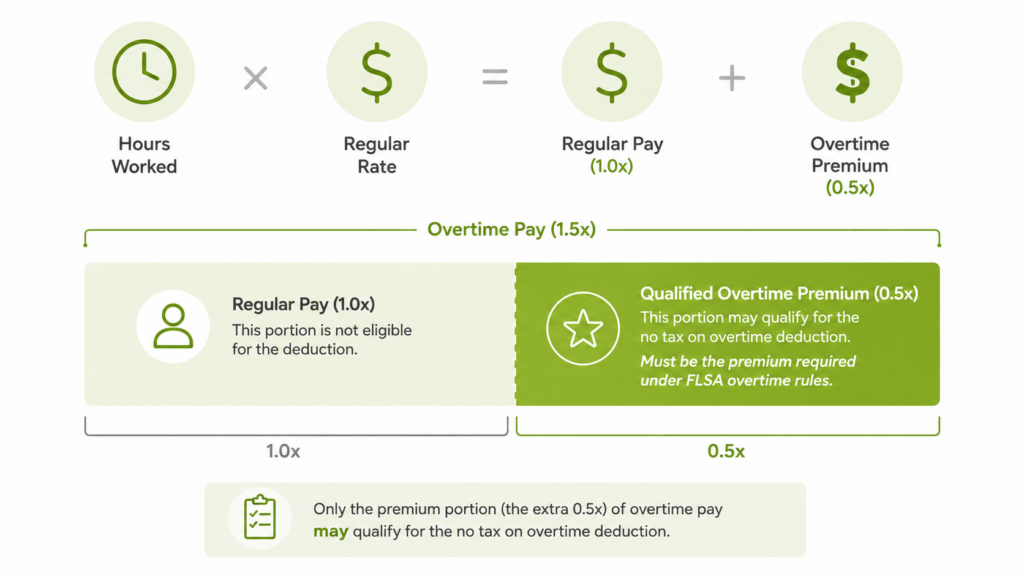
This is where most confusion lives. Only the premium portion of overtime qualifies, not the whole overtime paycheck. Under the Fair Labor Standards Act, overtime is paid at 1.5 times the regular rate. The deduction covers only the extra 0.5, the “half” in time-and-a-half, because that is the amount that exceeds the worker’s regular rate of pay.
A worked example makes it concrete:
An employee’s regular rate is $24 an hour. Their FLSA overtime rate is $36 an hour. Of that $36, the first $24 is regular pay and the extra $12 is the premium. Only the $12 per overtime hour is “qualified overtime.” If the employee works 250 overtime hours in the year, $3,000 (250 times $12) is deductible, not the full $9,000 they were paid for those hours.
The deduction is capped at $12,500 for single filers and $25,000 for married couples filing jointly. It begins to phase out once modified adjusted gross income exceeds $150,000 for single filers or $300,000 for joint filers, and it is reduced by $100 for every $1,000 of income above the threshold.
Is overtime still taxed in 2026?
Yes, in two important ways. First, overtime is still subject to payroll withholding during the year. Paychecks do not get bigger automatically, and Social Security and Medicare (FICA) taxes still apply to overtime in full. The benefit shows up as a lower tax bill or a larger refund when the worker files, not as a bump in take-home pay each week.
Second, the deduction is federal only. Unless a state chooses to conform, state income tax may still apply to overtime. Employers with staff in multiple states should be ready for that question.
Who qualifies for no tax on overtime?
- Workers who earn FLSA-required overtime, meaning the time-and-a-half premium for hours over 40 in a week. Overtime paid under a contract or state rule that federal law does not require may not qualify.
- Filers with a valid Social Security number. Married workers must file jointly to claim it.
- Workers under the income phase-out. The full deduction is available below $150,000 (single) and $300,000 (joint) in modified AGI.
What employers must do: the 2026 reporting change
This is the part that matters most for businesses, and the timeline has two stages.
2025: transition relief
For 2025, the IRS granted penalty relief. Employers are not required to separately report qualified overtime on 2025 Forms W-2 and will not be penalized for skipping it, as long as returns are otherwise complete and correct. Workers who do not receive a separate figure can calculate their deduction using the IRS Schedule 1-A instructions.
2026 and beyond: separate W-2 reporting required
Starting with the 2026 tax year, employers must separately report qualified overtime compensation on Forms W-2 and the relevant 1099s. That means your payroll system has to isolate the premium portion of FLSA overtime for every eligible employee across the year, which is not a number most systems tracked before this law.
Practically, employers should:
- Confirm your payroll system can isolate the FLSA overtime premium (the 0.5 portion) separately from regular and total overtime pay.
- Verify overtime is being classified correctly, because only federally required overtime qualifies, so misclassified “overtime” creates reporting errors.
- Prepare employee communications. Staff will ask why their paycheck did not change, so explain that the benefit is claimed at tax time.
- Coordinate multi-state payroll, since state treatment can differ from the federal deduction.
- Document your process so 2026 W-2s are accurate and defensible.
Why this matters for your business
The reporting requirement turns a tax-policy headline into a payroll-operations project. Get the premium-portion tracking wrong and your 2026 W-2s are wrong, which pushes the problem onto every employee’s tax return. Getting it right is exactly the kind of behind-the-scenes compliance work an outsourced HR and payroll partner is built to handle.
Frequently Asked Questions
The deduction is effective for the 2025 tax year, so overtime earned in 2025 is eligible and workers first claim it on the return filed in early 2026. It runs through the 2028 tax year unless it is extended.
Only the premium portion of FLSA overtime qualifies, meaning the extra 0.5 of time-and-a-half that exceeds the regular rate, not the whole overtime paycheck. Workers deduct that amount, up to $12,500 (single) or $25,000 (joint), on their federal return.
Yes. Overtime is still subject to payroll withholding and to Social Security and Medicare taxes. The deduction lowers federal income tax when the worker files their return. It does not increase weekly take-home pay, and state income tax may still apply.
Workers who earn FLSA-required overtime, have a valid Social Security number, and fall under the income phase-out of $150,000 (single) or $300,000 (joint) in modified AGI. Married workers must file jointly to claim it.
For 2025 there is penalty relief and no required separate reporting. Beginning with the 2026 tax year, employers must separately report qualified overtime compensation on Form W-2, which means payroll must isolate the FLSA overtime premium for each eligible employee.
Up to $12,500 for single filers and $25,000 for married couples filing jointly. The deduction phases out above $150,000 (single) and $300,000 (joint) in modified adjusted gross income.
This article is general information, not tax or legal advice. Rules can change and individual situations vary, so confirm specifics with a qualified tax professional or with the IRS before making decisions.
Kona HR keeps payroll and W-2 reporting compliant as the rules change, including the new qualified-overtime tracking that starts with 2026. Talk to our compliance team about getting your payroll set up correctly before year-end.