What is the difference between HR consulting and HR outsourcing? HR consulting is advice. HR outsourcing is execution. A consultant studies a specific people problem, recommends a fix, and hands the plan back to your team. An outsourcing provider takes over ongoing HR work, like payroll and benefits administration, and runs it for you every month.
Consulting usually has a start date and an end date. Outsourcing usually runs on a monthly fee with no end date at all.
Most growing companies need both at some point. The HR outsourcing vs. HR consulting decision comes down to matching the model to the problem in front of you. Here is how each one works, what each one asks you to give up, and how to choose.
HR consulting is advice. HR outsourcing is execution.
HR consulting is a project-based advisory service. An outside HR expert assesses a defined problem and designs a solution. Your team then puts it in place, sometimes with the consultant’s help on a short engagement.
Typical consulting projects include a handbook rewrite, a compensation structure, a compliance audit, a workplace investigation, and HR due diligence before an acquisition. Each one ends with a clear deliverable.
HR outsourcing, often shortened to HRO, is an ongoing service. An outside provider takes responsibility for running one or more HR functions on your behalf. The usual scope covers payroll processing, benefits administration, onboarding, leave tracking, recordkeeping, and day-to-day employee questions.
The simplest test is frequency. If the work repeats every pay period or every year, it is an outsourcing candidate. If it happens once and changes how you operate, it is a consulting project.
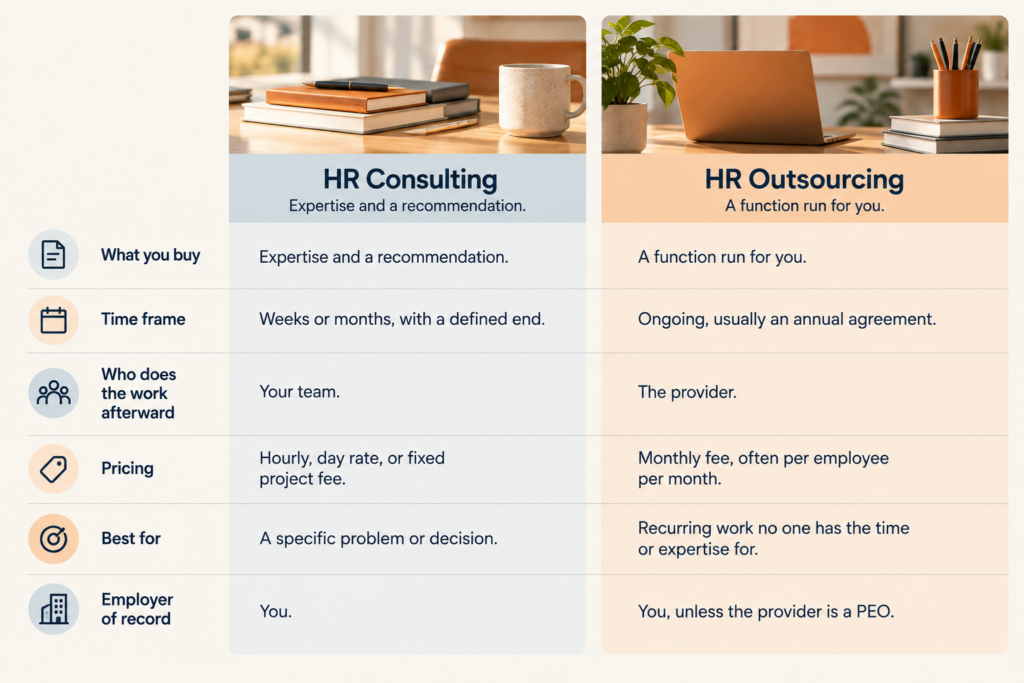
HR outsourcing vs. HR consulting, side by side
| HR consulting | HR outsourcing | |
| What you buy | Expertise and a recommendation | A function run for you |
| Time frame | Weeks or months, with a defined end | Ongoing, usually an annual agreement |
| Who does the work afterward | Your team | The provider |
| How it is priced | Hourly, day rate, or fixed project fee | Monthly fee, often per employee per month |
| Best for | A specific problem or decision | Recurring work no one has the time or expertise for |
| Who stays the employer | You | You, unless the provider is a PEO |
For real numbers on the outsourcing side, see what HR outsourcing costs. The last row of the table matters more than most buyers realize. It is where the outsourcing market splits.
HR outsourcing comes in several models
HR outsourcing covers a few different arrangements. The biggest difference between them is who the IRS treats as the employer.
| Model | How it works | Employer of record |
| PEO (professional employer organization) | Co-employment. The PEO puts your staff on its payroll and files payroll taxes under its own EIN. Employees usually move onto the PEO’s benefits plans. | The PEO, for tax purposes. You still direct the work. |
| ASO (administrative services organization) | The provider runs payroll and HR administration. You keep your own benefits plans and carry the employer liabilities. | You |
| Outsourced HR (HRO) | The provider runs the HR functions you choose, from payroll to compliance to employee relations, with no co-employment. | You |
| Fractional HR | A senior HR leader works for you part-time on a retainer, embedded with your leadership team. | You |
Kona HR is not a PEO. We run outsourced HR without co-employment. Your company stays the sole employer, keeps its own benefits plans, and keeps control of its own policies.
A fractional HR leader sits between the two models. It is consulting-level expertise delivered on an ongoing basis, usually for companies that need strategy more than administration.
HR consulting fits a problem with clear edges
Choose consulting when the need is specific and time-bound. These are the most common triggers.
- You already have HR staff, but they need a specialist for one issue, such as a pay equity review or a complicated leave case.
- You are approaching a headcount threshold. At 50 employees, the FMLA and the ACA employer mandate both apply. A gap audit beforehand costs far less than a claim afterward.
- You are buying, selling, or merging a business and need HR due diligence on the other side’s plans, policies, and liabilities.
- You want an outside view before a decision you cannot easily reverse, such as a restructuring or a reduction in force.
- A complaint has come in that calls for an independent investigation.
In each case the consultant’s job ends when the plan is delivered. Someone on your team has to own it from there. If no one can, you probably need more than a consultant.
HR outsourcing fits work that never stops
Choose outsourcing when HR is a steady stream of tasks rather than a single problem. It tends to show up in recognizable ways.
- HR sits with a CFO, controller, or office manager whose real job is something else.
- Payroll corrections, missed enrollment deadlines, or late new-hire paperwork keep repeating.
- You have employees in more than one state, each with its own payroll registrations and leave rules.
- You are a new fund, firm, or startup that needs institutional-grade HR from day one without building a department.
For the full checklist of warning signs and headcount thresholds, see our guide on when to outsource HR. For the cost and risk argument, see why companies outsource HR.
Many companies use both
The two models are not rivals. The most common pattern is outsourcing the administration and bringing in consulting for strategy. Payroll and benefits run in the background. A compensation redesign or a handbook overhaul becomes a defined project.
The reverse also works. A company with a capable in-house HR generalist often keeps that person and adds consulting support for specialist questions, like multi-state compliance or executive pay.
Using one firm for both removes a handoff. The people who advise on the policy are the same people who administer it.
Four questions settle the decision
Most HR outsourcing vs. HR consulting decisions resolve quickly once you answer these honestly.
- Is the work recurring or one-time? Recurring work points to outsourcing. One-time work points to consulting.
- Is there someone to implement the recommendation? If not, a consulting report will sit on a shelf.
- Do you want to stay the sole employer of record? If so, rule out a PEO and look at outsourced HR or an ASO.
- What does a mistake cost here? The higher the penalty exposure, the more the work belongs with a specialist on an ongoing basis.
Where Kona HR fits
Kona HR does both. We take on project-based HR consulting, from handbook and compensation work to HR due diligence on acquisitions. We also run outsourced HR services on an ongoing basis, including payroll, benefits administration, compliance, and employee relations, without co-employment.
That means HR outsourcing vs. HR consulting is not a permanent choice. You can start with a project and move to ongoing support, or the other way around, without changing firms. We support businesses nationwide from offices in New York, Palm Beach, Denver, Southport, and Richmond, with particular depth in hedge funds and private equity firms.
Frequently asked questions
What is the difference between HR consulting and HR outsourcing?
The difference between HR consulting and HR outsourcing is who does the work. An HR consultant assesses a specific problem and recommends a solution, usually on a defined project. An HR outsourcing provider takes over recurring HR functions, such as payroll and benefits administration, and runs them for you on an ongoing basis.
What is HR consulting?
HR consulting is a project-based advisory service in which an outside HR expert assesses a defined people issue and designs a solution. Common projects include handbook rewrites, compensation structures, compliance audits, workplace investigations, and HR due diligence for acquisitions. The engagement ends when the deliverable is complete and handed to your team.
Is HR outsourcing the same as a PEO?
HR outsourcing is not the same as a PEO. A PEO is one type of HR outsourcing that uses co-employment, becoming the employer of record for tax purposes and filing payroll taxes under its own EIN. Other outsourced HR models, including ASOs and non-PEO outsourced HR, leave your company as the sole employer.
What is an ASO in HR outsourcing?
An ASO, or administrative services organization, is an HR outsourcing model in which the provider handles payroll and HR administration while your company remains the employer of record. You keep your own benefits plans and carriers, and you retain the employment-related liabilities that a PEO would otherwise share through co-employment.
What is a fractional HR consultant?
A fractional HR consultant is a senior HR leader who works for your company part-time on an ongoing retainer. The role gives you strategic HR leadership, such as policy, compensation, and workforce planning, without the cost of a full-time executive. It sits between project-based consulting and full HR outsourcing.
Can a company use HR consulting and HR outsourcing at the same time?
A company can use HR consulting and HR outsourcing at the same time, and many do. The common setup is outsourcing recurring administration like payroll and benefits while using consulting for defined projects like a compensation redesign. Working with one firm for both keeps the advice and the administration aligned.
Is HR consulting or HR outsourcing cheaper?
Whether HR consulting or HR outsourcing is cheaper depends on the need. Consulting is a finite cost tied to one project. Outsourcing is a recurring monthly cost, but it often replaces an internal hire. For context, the median U.S. HR manager salary was $140,030 in May 2024, according to the Bureau of Labor Statistics.
Start with the problem, not the service model
Tell us your headcount, your states, and what is on your plate right now. Kona HR will tell you whether it calls for a project, ongoing support, or both, and what each would look like for your business.