What is benefits administration outsourcing? It is handing the operational side of your employee benefits program to a third party: enrollment, eligibility, carrier feeds, payroll deduction reconciliation, COBRA, ACA reporting, and Form 5500. Employers typically pay $5 to $30 per employee per month for software alone, or bundle it into full-service HR at $100 to $250 per employee per month.
The reason employers look at it is rarely the software. It is that benefits administration has become a compliance function wearing an administrative costume, and the penalty for getting it wrong now exceeds what the service costs. Here is what full-service benefits administration includes, what it costs, and how to tell whether your current setup is working.
What does benefits administration include?
Most employers think of benefits administration as open enrollment. Open enrollment is roughly six weeks of it. The other forty-six weeks look like this.
| Area | What it actually involves |
| Enrollment and eligibility | New hire enrollment and waiting period tracking, qualifying life event processing and documentation, termination and coverage end-date handling with carrier-specific proration rules, dependent eligibility verification. |
| Carrier and payroll operations | EDI feeds or manual enrollment to every carrier across medical, dental, vision, life, disability, and each voluntary line. Monthly reconciliation of carrier invoices against actual enrollment. Verification that payroll deductions match elections every pay period. Resolution when the carrier file and the HRIS disagree. |
| Compliance | ACA measurement, affordability testing, and Forms 1094-C and 1095-C. Form 5500 and Summary Annual Report. COBRA notices, elections, and premium tracking. SPD, SBC, and required annual notices. PCORI for self-funded and level-funded plans. Section 125 and 105(h) nondiscrimination testing. |
| Employee support | Answering coverage questions, which is where the hours actually go. Claims escalation and carrier advocacy. Enrollment education and decision support. |
The compliance row is the one that has changed. Ten years ago it was a filing cabinet. Today it is a set of dated obligations with per-form and per-day penalties attached.
What does benefits administration cost in-house?
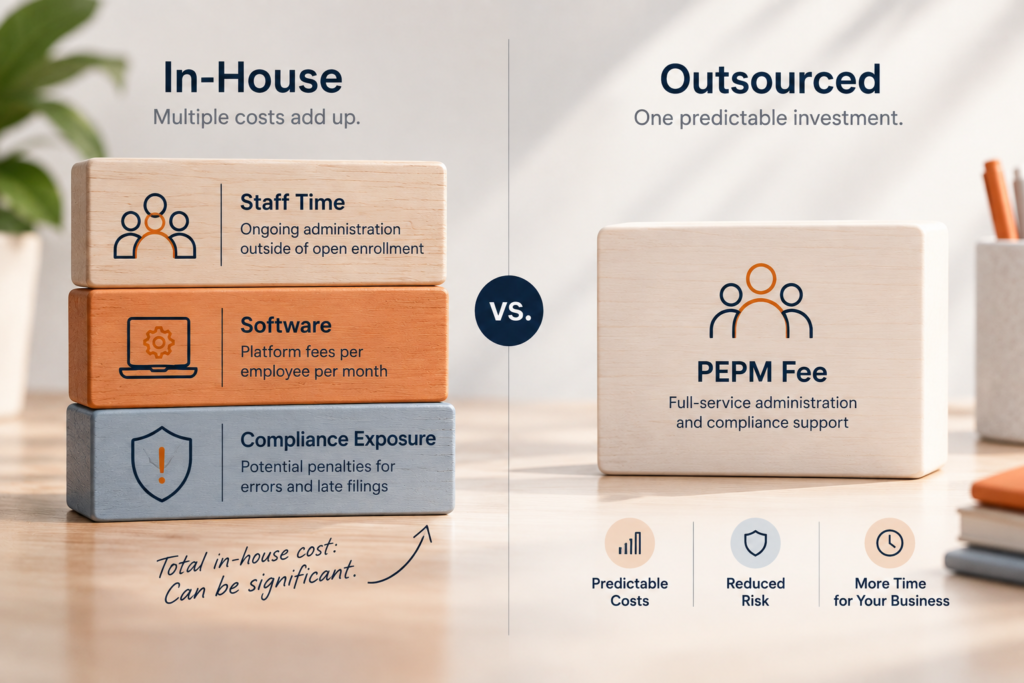
The invoice cost is close to zero, which is why so many employers never examine it. The real cost shows up in three places.
Staff time. Benefits enrollment and reconciliation for a 50-person company routinely runs 15 to 25 hours a month outside open enrollment, and two to four times that during it. If that work sits with an office manager at $35 an hour loaded, that is roughly $8,000 to $12,000 a year. If it sits with a founder or COO whose time prices at $125 an hour, the same workload is $30,000 or more.
Software. Standalone benefits administration platforms run $5 to $30 per employee per month. For 25 employees that is $1,500 to $9,000 annually, before anyone is actually doing the work the software surfaces.
Compliance exposure. This is the item that dwarfs the other two.
| Failure | 2026 penalty |
| Late or incorrect Form 1095-C, corrected after August 1 | $340 per form |
| Same, intentional disregard | $680 per form, no cap |
| Late Form 5500 | Up to $2,739 per day, per plan |
| Failure to furnish SPD on request | $110 per day |
| Missed COBRA election notice | $110 per day, per qualified beneficiary |
| ACA employer mandate, no offer of coverage (Penalty A) | $3,340 per full-time employee, minus the first 30 |
| ACA employer mandate, unaffordable coverage (Penalty B) | $5,010 per subsidized employee |
For a 60-person applicable large employer, one botched 1095-C run across all forms is roughly $20,000. A single missed Form 5500 across three plans for one year is theoretically catastrophic. These are not hypotheticals. IRS penalty notices for ACA reporting typically arrive 18 to 24 months after the reporting year, long after the person who made the error has moved on.
What does benefits administration outsourcing cost?
Pricing depends entirely on scope. Three common structures:
| Model | What you get | Typical cost |
| Software only | Enrollment portal, carrier feeds, document storage. You still do the work. | $5 to $30 PEPM |
| Benefits administration services | Enrollment, eligibility, reconciliation, COBRA, ACA filings, employee support | $15 to $50 PEPM |
| Full-service HR including benefits | The above plus payroll, HR compliance, employee relations, handbook and policy | $100 to $250+ PEPM |
For a 50-employee company, dedicated benefits administration services generally run $9,000 to $30,000 a year. Compare that against loaded staff time, the software you were buying anyway, and a single avoided ACA reporting penalty, and the arithmetic usually resolves quickly. This is a mature category, not an experiment: the global benefits administration outsourcing market reached roughly $83.6 billion in 2025 and continues growing at about 7 percent annually.
Software or a service? How to tell which you need
Benefits administration software and benefits administration outsourcing solve different problems, and buying the wrong one is the most common mistake employers make here.
Software is enough when headcount is stable and under about 40, you offer two or three plan lines rather than eight, someone internal genuinely understands ACA measurement and COBRA timing and Form 5500 requirements, you operate in one or two states, and turnover is low enough that life-event volume stays manageable.
You need a service when you are an applicable large employer or approaching 50 full-time equivalents, you operate in multiple states with different mandates and leave laws, you have high turnover or seasonal or variable-hour employees that make ACA measurement genuinely hard, your plan is self-funded or level-funded and therefore adds PCORI and 5500 and 105(h) testing, nobody on staff can name the Form 5500 deadline without looking it up, or the person doing benefits today has a different job title.
Software makes the work visible. It does not make the work go away, and it does not sign the filing.
What changes at 50 employees
Crossing 50 full-time equivalents converts benefits administration from a task into a regulated function. At that threshold you become an applicable large employer, which means you must offer minimum essential coverage providing minimum value to at least 95 percent of full-time employees and their dependents, that coverage must be affordable, you must measure full-time status correctly using a monthly or look-back method applied consistently, you must file Forms 1094-C and 1095-C annually, and you are exposed to Penalty A and Penalty B if any of that fails.
| Plan year | ACA affordability threshold | Source |
| 2026 | 9.96% | IRS Rev. Proc. 2025-25 |
| 2027 | 10.22% | IRS Rev. Proc. 2026-26. First time above 10 percent. |
The 2027 increase is worth acting on, not just noting. It means employers can charge employees somewhat more for self-only coverage while still clearing the affordability test. For plan years beginning January 1 through June 1, 2027, the federal poverty line safe harbor is satisfied at an employee contribution of no more than $135.92 per month. If you set contributions this fall without updating for the new percentage, you are likely leaving budget on the table.
Most employers cross 50 without noticing until a penalty notice arrives. That is the most common reason mid-sized companies come to us mid-year.
What good benefits administration looks like
Whether you keep it in-house or hand it off, these are the markers.
- A single source of truth. Enrollment lives in one system that feeds payroll and every carrier. If your HRIS, your payroll file, and the carrier roster ever disagree, someone is going to lose coverage at a doctor’s office.
- Monthly invoice reconciliation, not annual. Carrier bills drift and terminated employees stay on invoices for months. Catching it in month one is a correction. Catching it in month eleven is a write-off.
- A compliance calendar with an owner’s name on it. Form 5500, PCORI on the second-quarter Form 720 by July 31, the 1094-C and 1095-C March deadlines, and annual notices at open enrollment.
- Documented life-event processing. Thirty-day windows, required documentation, and a record of what was submitted and when.
- Employee support that is not you. If your team emails the CFO with dental questions, the CFO is the benefits department.
Why employers hand it off before renewal season
The practical answer is timing. Roughly 80 percent of group benefits renew on January 1, which means September through November is when plan modeling, carrier negotiation, enrollment build, employee communication, and payroll deduction updates all stack into the same twelve weeks.
An internal team that manages benefits comfortably in March is usually underwater in October. That is when errors get made: wrong deduction amounts loaded, life events missed, an employee who thinks they enrolled and did not. Handing off before that window is the difference between a transition and a rescue.
Where Kona HR fits
Kona HR provides full-service benefits administration as part of a broader HR partnership, not as standalone software with a support inbox. We run enrollment and eligibility, reconcile carrier invoices monthly, own the ACA measurement and filings, administer COBRA, handle the Form 5500 and PCORI calendar, and answer your employees’ benefits questions directly so your managers do not have to.
Because the model is flexible and not a PEO, you can hand off benefits administration alone or fold it into a broader program across payroll, compliance, and HR technology. We support businesses nationwide from offices in New York, Palm Beach, Denver, Southport, and Richmond, which means multi-state mandate variation is a normal part of the job rather than an exception discovered in January.
Frequently Asked Questions
Benefits administration outsourcing is contracting a third party to run the operational and compliance side of your employee benefits program, including enrollment, eligibility tracking, carrier feeds, payroll deduction reconciliation, COBRA, ACA reporting, and Form 5500 filing. The employer still sponsors the plans and selects the carriers.
Software-only platforms run $5 to $30 per employee per month. Dedicated benefits administration services generally run $15 to $50 per employee per month. Full-service HR outsourcing that includes benefits administration runs $100 to $250 or more per employee per month. For a 50-person company, dedicated benefits administration typically lands between $9,000 and $30,000 a year.
Enrollment and eligibility management, qualifying life event processing, carrier EDI feeds, monthly invoice reconciliation, payroll deduction verification, COBRA administration, ACA measurement and Forms 1094-C and 1095-C, Form 5500 filing, PCORI for self-funded plans, required employee notices, and day-to-day employee benefits support.
Software is generally sufficient for stable employers under about 40 employees with simple plan designs, low turnover, single-state operations, and someone internal who understands ACA and ERISA requirements. Once you approach 50 full-time equivalents, operate in multiple states, self-fund, or have high turnover, a service is usually the better economics because the compliance exposure exceeds the fee.
The 2026 penalty is $340 per form for returns corrected after August 1, and $680 per form where the IRS finds intentional disregard, with no cap. Penalties apply separately for failing to file with the IRS and failing to furnish to employees, so a single error can be assessed twice.
At 50 or more full-time equivalent employees, calculated across the prior calendar year. At that point you must offer affordable minimum essential coverage providing minimum value to at least 95 percent of full-time employees and their dependents, and file Forms 1094-C and 1095-C.
For plan years beginning in 2027 the affordability threshold is 10.22 percent of household income, up from 9.96 percent in 2026, per IRS Rev. Proc. 2026-26. It is the first time the percentage has exceeded 10 percent. Non-calendar-year plans continue using 9.96 percent until their new plan year begins.
Ninety to one hundred twenty days before your plan year begins. For a January 1 renewal, that means September or October. Switching during open enrollment is possible but adds real risk to enrollment accuracy and payroll deductions.
Hand off benefits administration before open enrollment
Tell us your headcount, your states, and how many carriers you are running. Kona HR will scope benefits administration bundled or a la carte, take over the enrollment and compliance calendar, and have it running before your January 1 renewal.